
Standard Error vs Standard Deviation In Biology
Biology experiments are highly dependent on data interpretation. Researchers measure variation to know how reliable their results are. Statistics help scientists to explain patterns instead of guessing. Among the most important concepts students encounter is standard error vs standard deviation in biology.
These terms are seen by many biology students in lab reports and exam questions. At first, they seem to be very similar and actually quite confusing. However, each measurement is a different story about data. Understanding what their purpose is will help you analyze experiments with confidence.
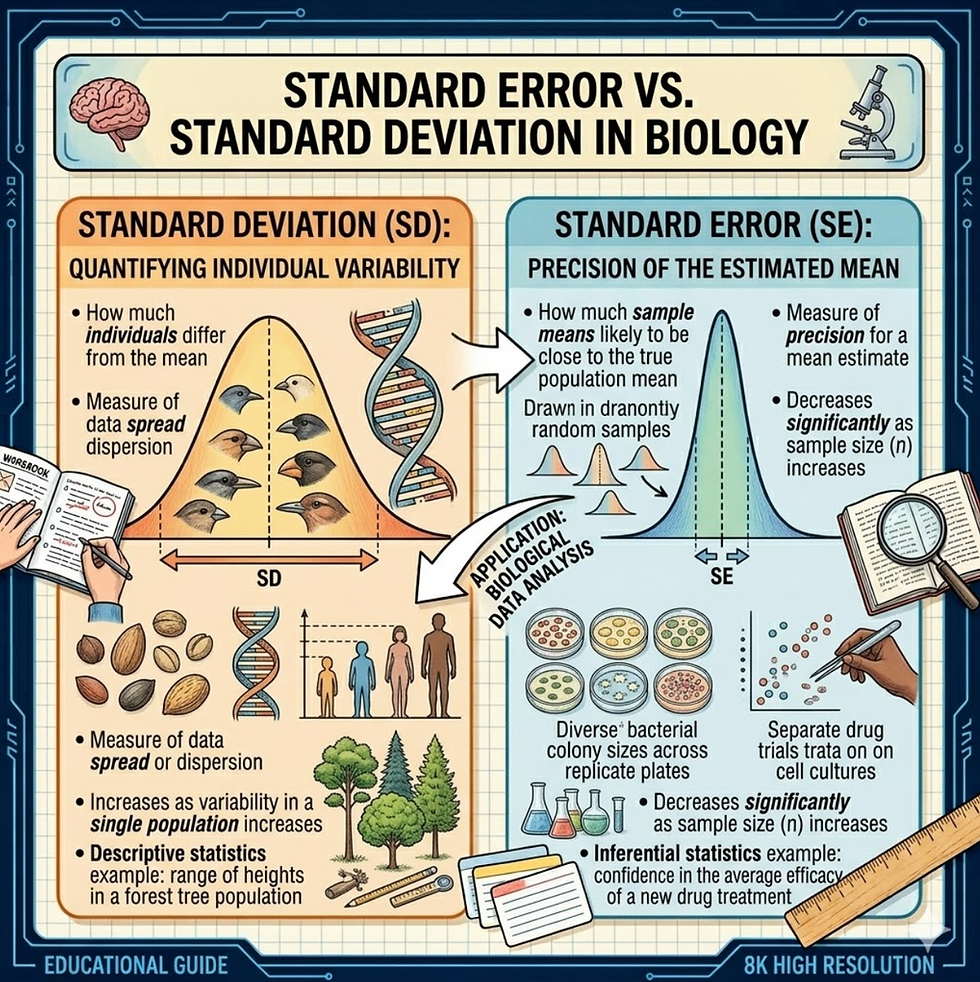
Caption: Image describing difference between standard error and standard definition.
Understanding Variation in Biological Data
Also, biological systems tend not to give the same results each time. Little differences can be observed because organisms and environments vary naturally. Scientists measure this variation to determine how spread out the results are. One key measurement for this is standard deviation in biology experiments.
Standard deviation indicates the variation of individual values of a parameter from the average value. A small standard deviation indicates that the results are close to the mean. A large standard deviation implies that the values are spread across a wide range in the data set. This measurement shows the consistency of experimental results.
The calculation of variation is a common method of calculation when the scientist tests for plant growth, enzyme activity, or population sizes. Clear measurements help scientists judge whether or not results are reliable. Without analysis of the variation, conclusions could easily become misleading. Statistical tools therefore play a central role in modern biology.
What Is Standard Deviation?
Standard deviation is a measure of how the individual results are distributed within the mean. Biologists use it when they are interested in knowing variation within a sample. If a large number of results are close to the mean, the deviation is small. If the results become spread out, the difference becomes greater.
Consider a simple experiment on plant growth. Students make height measurements of several plants after giving some fertilizer. Some plants get a little bit taller while others become a little bit shorter.
Calculating standard deviation in biology experiments shows how consistent those measurements are. Researchers use this value when trying to study natural variability. Standard deviation is used by scientists to better understand the randomness. This insight is supporting more powerful conclusions from experiments.
Bio math can be difficult, get a scientist tutor to help you understand! Check us out here.
What Is Standard Error?
The standard error is a different way from measuring the standard deviation. Instead of describing within data variation, it constitutes an estimation of the accuracy of the sample mean. Scientists use standard error in biology statistics to understand how close the sample average is to the true population mean.
The smaller the standard error the more reliable the mean. Imagine carrying out the same experiment thousands of times. The result of each experiment gives slightly different averages. Standard error is a prediction of how much those averages vary. It therefore represents the reliability of the calculated mean. Standard error is often shown by researchers on graphs with the help of error bars.
These bars are a graphical representation of uncertainty around the mean value. Smaller error bars mean a greater confidence in the data. Larger error bars indicate larger uncertainty. Understanding standard error vs standard deviation in biology becomes easier once you see this difference.
Standard deviation is concerned with the spread of data. Standard error is concerned by mean reliability. Both measurements are consistent with scientific interpretation.
What Is the Difference Between Standard Error and Standard Deviation in Biology?
Although they are related to variation, they explain different aspects of data. Standard deviation is a measure of the variation of individual values compared with the mean. Standard error estimates the accuracy of calculated mean.
Another important difference is in sample size. Standard error is reduced as the sample size increases. More data collected means a more reliable average. Standard deviation, on the other hand, is primarily influenced by the extent to which data is spread out.
Understanding the difference between standard error and standard deviation helps students interpret research papers. Scientists select each statistic for a specific purpose. Recognizing their roles helps with better lab reports as well as answers to exams. Clarity in Statistics Enhances Scientific Communication.
If you want to learn more such complex concepts, book a free trial class with a scientist here.
When Should You Use Standard Error in Biology Experiments?
Scientists use standard error when they want to show how good a mean value is. It is seen frequently in graphs of averages between groups. It is relied on by researchers when presenting results that are summarized. For example, consider the measurement of the activity of an enzyme in several test tubes. You calculate an average rate of the experiment.
Displaying standard error in biology statistics on the graph shows how trustworthy that mean is. Smaller error bars are a measure of greater confidence in the result. This statistic is also useful in helping scientists compare experimental treatments. If two means are found to be significantly differentiated, researchers go further. Standard error gives a graphical indication of reliability. Interpreting those clues supports better scientific conclusions.
Why Do Biologists Use Standard Deviation in Data Analysis?
The answer is to understanding natural variation. Living beings rarely perform the same activities each time. Variability such as this is clearly captured by the standard deviation. In ecology studies, scientists take population size in different habitats. Some places show higher numbers as well as fewer organisms at others.
Calculating standard deviation in biology experiments shows how widely those numbers vary. This information is used by researchers to help understand patterns of the environment. Biologists also use standard deviation on genetics experiments.
Variation emerges in the measurement of characteristics like the height of plants or the production of enzymes. Tracking this spread is helping scientists to analyze biological diversity. Clear statistical analysis provides support for experimental conclusions.
Why Understanding Both Statistics Matters
Biology students usually get confused with these two statistics in exams. Learning the concept of standard error vs standard deviation in biology removes that confusion. Each measurement responds to a different scientific question. Together, they are a comprehensive picture of experimental data. Standard Deviation describes the scattering of data.
Standard error is the way in which the mean value will become reliable. Combining both statistics makes it possible to interpret experiments more deeply. Scientists therefore depend on them regularly. Graphs, lab reports and research papers often contain these measurements. It is important for students to recognize their meaning to properly read the results of scientific research. Confidence develops when one becomes familiar with statistical language. Understanding data brings ultimate strength to the scientific thought.
Conclusion
Statistics are still needed in the interpretation of biological experiments. Concepts like standard error vs standard deviation in biology help scientists understand variation and reliability. Standard deviation is a measure of the amount of spreading of results around the mean.
Standard error is an estimate of the accuracy of the average. Students who know these sorts of things think about experiments more effectively. Clear statistical thinking gives an edge to lab reports and exam answers. Practicing with actual datasets helps to gain confidence fast. Biology becomes so much more meaningful when strong data interpretation skills are present.
Comments